


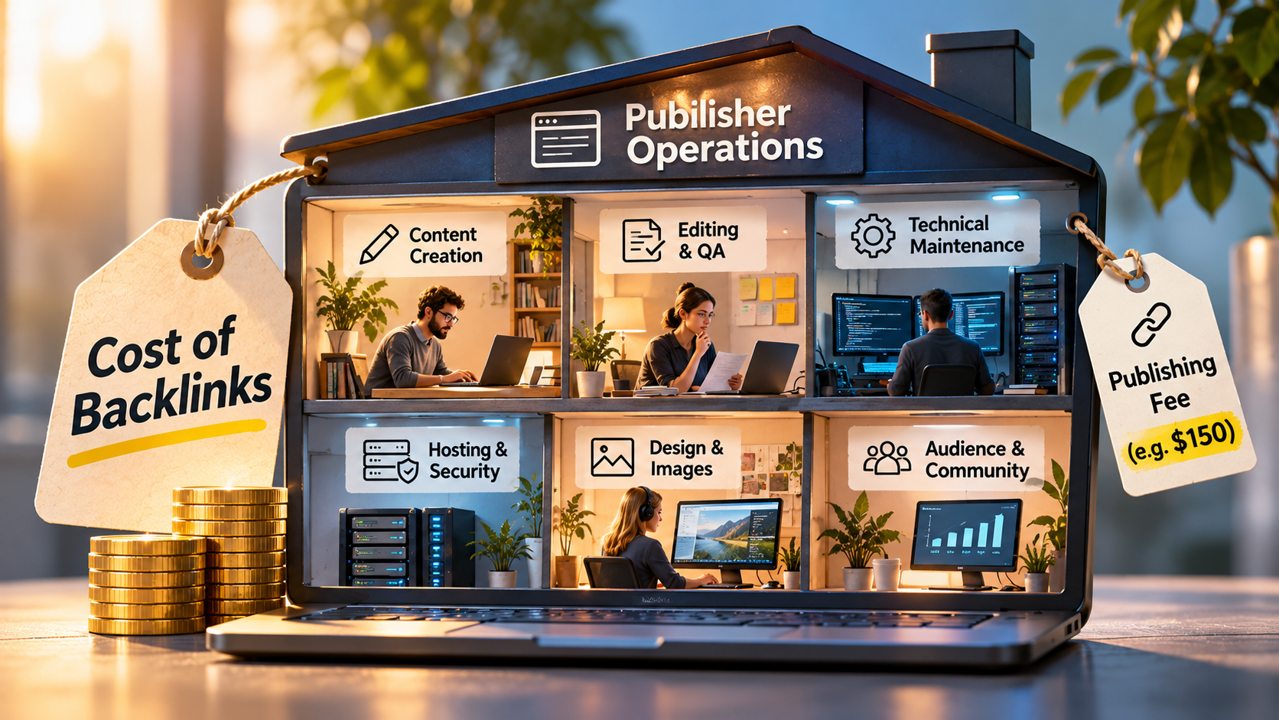
The cost of backlinks is usually discussed from the buyer's perspective. Businesses compare prices, SEO agencies negotiate discounts, and marketing managers search for publications that fit their budgets. But there's another side to the industry that receives far less attention: the people who actually own and operate the websites.
Every published article appears somewhere. Behind that website may be an independent blogger, a small editorial team, or an established media company with employees, hosting expenses, software subscriptions, and advertising targets.
For these publishers, selling editorial space isn't necessarily a matter of earning easy money.
Running a credible website costs money. Sometimes considerably more than outsiders expect.
Understanding those expenses reveals why backlink prices vary so dramatically and why a publication costing $150 might represent a reasonable business transaction rather than an inflated SEO fee.
Behind the Screen: What Does It Cost to Run a Publishing Website?
Imagine a small independent magazine covering sustainable architecture.
It publishes interviews with architects, practical building guides, and articles about energy-efficient homes.
The website attracts a loyal audience, but maintaining that readership requires consistent work.
Its owner must pay for hosting, security, technical maintenance, editorial production, and occasionally professional photography.
Even before considering advertising or sponsored publications, the website has operating expenses.
A hypothetical monthly budget might look like this:
| Expense | Monthly cost |
|---|---|
| Hosting and technical services | $80 |
| Website maintenance and security | $120 |
| Editorial writing and research | $600 |
| Images and design | $150 |
| Software and administration | $100 |
| Total | $1,050 |
These figures are illustrative, not industry averages.
Some publishers operate websites for much less. Others spend tens of thousands of dollars monthly on editorial teams and technical infrastructure.
The important point is that publishing opportunities exist within businesses that need to cover their expenses.
And that influences the backlink price customers encounter.
Why Publishers Charge for Sponsored Articles
Editorial publications have several potential revenue sources.
Some earn money through display advertising. Others rely on subscriptions, affiliate commissions, sponsorships, or partnerships.
Sponsored articles represent another possible income stream.
A business pays for an opportunity to present useful information to the publication's audience, subject to the publisher's editorial rules.
The publisher receives compensation for reviewing, preparing, and distributing the content.
However, a reputable publication must balance commercial income with reader trust.
Accepting every sponsored submission could gradually reduce editorial quality.
For example, a specialist architecture magazine might reasonably publish a sponsored guide about sustainable insulation materials.
An unrelated article promoting online gambling would be much harder to justify.
This is where the economics become interesting.
A publisher that carefully selects commercial partnerships may accept fewer paid articles while charging more for each placement.
Its link building pricing is partly influenced by the editorial standards it wants to maintain.
The Publisher's Dilemma: Revenue vs. Reputation
Consider a fictional website owner named Daniel.
He operates a technology publication that attracts approximately 40,000 monthly visits.
Over several years, he has built an audience interested in software development, cybersecurity, and business technology.
One morning, he receives an offer.
A marketing company wants to publish ten sponsored articles for $50 each.
The proposed topics have almost nothing to do with technology.
The offer represents $500 in immediate revenue.
But Daniel hesitates.
"If I fill my website with irrelevant articles, why would my regular readers keep coming back?"
His concern illustrates a fundamental tension in commercial publishing.
Short-term revenue can conflict with long-term editorial credibility.
A publisher who rejects unsuitable content may earn less money today but preserve the publication's reputation and audience.
That reputation can also influence future publishing fees.
For buyers, this explains why the cheapest available placement isn't always the most attractive option.
How Publishers Calculate Their Publication Fees
There is no universal formula for setting sponsored article prices.
Some publishers begin with their operating costs.
Others consider audience size, market demand, website reputation, or the time required to review submissions.
Let's examine a hypothetical example.
A small publisher spends $1,200 monthly maintaining and producing content for a specialist website.
Advertising and affiliate income generate $700.
That leaves a $500 gap before the website covers its monthly operating expenses.
If the publisher accepts five suitable sponsored articles at $100 each, those publications could cover the remaining amount.
Of course, this calculation ignores taxes, additional editorial costs, and the owner's desired profit.
Nevertheless, it demonstrates how publishing fees can form part of a sustainable business model.
A larger publication may require higher fees because its operating expenses and editorial requirements are greater.
The resulting cost of backlinks can therefore reflect genuine publishing economics rather than arbitrary pricing.
The Cost of Creating a Quality Article
One frequently overlooked expense is content production.
A useful article doesn't appear automatically.
Depending on the subject, a writer may need to research technical information, interview specialists, verify facts, and organize complex material.
An editor then reviews the article for clarity, accuracy, and suitability.
For a general lifestyle article, this process might be relatively straightforward.
For a detailed explanation of financial regulations or medical technology, the requirements can be considerably more demanding.
Suppose a publisher pays a freelance writer $70 for an article and spends another $30 on editing and formatting.
The publication already represents $100 in direct content expenses.
If the publisher also needs to cover hosting, administration, and profit, a final fee of $150 or $200 becomes easier to understand.
This is why comparing the cost of link building without examining content requirements can be misleading.
Two publications may include very different levels of editorial work.
Why Some Websites Sell Articles for Just $10
At the other end of the market, certain websites advertise extremely inexpensive publishing opportunities.
How can they operate at such low prices?
Several explanations are possible.
A website owner may have minimal hosting expenses and produce most content independently.
A small publication may offer introductory prices to attract its first advertisers.
Some websites operate in markets where labor and operating costs are relatively low.
Others rely on automated content production or accept large quantities of commercial submissions.
These approaches aren't equivalent.
A low price doesn't automatically indicate poor quality, just as a high price doesn't guarantee strong editorial standards.
However, businesses should investigate whether the website has a genuine audience and whether its content serves a clear purpose.
If a publisher accepts hundreds of unrelated articles with virtually no editorial review, the low backlink price may reflect a business model focused primarily on selling links rather than serving readers.
The Role of SEO Metrics in Publisher Pricing
Publishers don't always base their fees on operating expenses.
Many use third-party SEO metrics to estimate what advertisers might be willing to pay.
Domain Authority, Domain Rating, organic traffic estimates, and referring domain counts frequently appear in commercial publishing discussions.
A website with DR 65 may charge substantially more than a website with DR 25.
But those numbers don't directly reveal the publisher's expenses or editorial quality.
Domain Rating and Domain Authority are proprietary metrics created by SEO software providers. They are not official Google ranking scores.
A smaller publication with knowledgeable writers and loyal readers may have lower authority metrics while offering excellent audience relevance.
Conversely, a website with impressive metrics may publish generic content with little genuine engagement.
For buyers evaluating link building prices, the lesson is to examine both the publication's audience and its editorial standards.
A metric should support a decision, not replace it.
How Agencies and Marketplaces Affect Publisher Revenue
Publishers rarely sell every sponsored publication directly to the final advertiser.
Many work with agencies, outreach specialists, or online marketplaces.
These intermediaries help connect publishers with businesses seeking relevant publishing opportunities.
The arrangement can benefit both sides.
Publishers gain access to potential customers without handling every marketing enquiry independently.
Businesses gain access to a broader selection of websites without contacting each publisher individually.
For example, marketplaces such as Bzoomer connect website publishers with advertisers looking for content publication opportunities across different industries and markets.
However, intermediaries also influence the final price.
A publisher might receive $80 for a placement that the customer purchases for $140.
The difference may cover platform operations, customer support, content coordination, or other services.
Understanding this relationship helps explain why the cost of backlinks sometimes exceeds the publisher's original fee.
What Happens When Publishers Become Too Dependent on Selling Links?
Sponsored publishing can provide useful revenue, but excessive dependence on paid placements creates risks.
Imagine a website publishing twenty commercial articles every week while producing only one independent editorial article.
Over time, readers may struggle to distinguish genuine editorial coverage from promotional content.
The website's topical focus can also deteriorate if commercial submissions cover unrelated subjects.
This can weaken audience trust and reduce the publication's value to advertisers.
There are also search engine considerations.
Google's spam policies prohibit buying or selling links that pass ranking credit for the purpose of manipulating search results.
Paid advertising and sponsored links should use appropriate attributes, such as rel="sponsored" or rel="nofollow".
Responsible publishers should clearly distinguish commercial content and maintain editorial standards.
A sustainable publishing business needs readers, not just paying advertisers.
Why Specialist Publishers Can Charge Premium Prices
Consider two websites.
The first covers general business news and accepts articles about almost any industry.
The second focuses exclusively on industrial robotics and automation.
The specialist website may have a much smaller audience.
However, its readers could include engineers, factory managers, purchasing specialists, and technology decision-makers.
For a company selling industrial automation equipment, reaching those readers may be commercially valuable.
The publisher understands that its audience is difficult to reach through generic advertising.
Consequently, it may charge higher fees for suitable sponsored content.
This illustrates why backlink price is not always proportional to total website traffic.
Audience relevance can matter more than audience size.
A small publication reaching the right professionals may offer better marketing opportunities than a large website attracting unrelated visitors.
The Economics of Long-Term Publishing Relationships
Not every publishing transaction needs to be a one-time purchase.
Businesses sometimes establish ongoing relationships with industry publications.
For example, a software company might contribute educational articles to a technology magazine several times a year.
The publisher receives relevant content and commercial support.
The company gains opportunities to reach a specialist audience.
Over time, both parties may develop a better understanding of editorial expectations.
This can reduce unnecessary revisions and coordination costs.
However, repeated commercial publications should remain transparent and appropriate for the audience.
The goal should be producing content that readers find genuinely useful.
A long-term relationship based exclusively on manipulating search rankings is fundamentally different from a legitimate editorial or advertising partnership.
What Buyers Can Learn From Publisher Economics
Understanding the publisher's perspective can improve purchasing decisions.
Before paying for a publication, consider what the fee might represent.
Does the website employ writers or editors?
Does it maintain a recognizable editorial focus?
Are sponsored submissions reviewed?
Does the publication attract readers interested in the subject?
Is the website regularly maintained?
These questions reveal more about potential value than a simple price comparison.
A $200 publication on a carefully managed specialist website may be reasonable.
A $200 placement on a neglected website filled with unrelated commercial articles may be difficult to justify.
The true cost of backlinks should be evaluated against publishing quality, audience relevance, and the services included.
Frequently Asked Questions About Backlink Costs
Why do website owners charge for publishing articles?
Publishers may charge fees to cover editorial work, website maintenance, administration, and access to their audiences. Sponsored content can form part of a publication's commercial revenue model.
How much does it cost a publisher to produce an article?
Expenses vary according to research requirements, writer expertise, editing, design, and technical work. Some articles require little additional spending, while specialist content can cost hundreds of dollars to produce.
Do publishers receive the entire amount paid for backlinks?
Not always. When agencies or marketplaces arrange publications, part of the final customer price may cover intermediary services and operating expenses.
Why do specialist websites sometimes charge more?
Specialist publications may offer access to professional audiences that are difficult to reach through general-interest websites. Their editorial requirements can also be more demanding.
Does a higher publication fee mean a better backlink?
No. Price alone doesn't establish quality. Businesses should examine editorial standards, audience relevance, website history, and the purpose of the publication.
Final Thoughts: The People Behind the Price
The cost of backlinks is shaped by more than SEO metrics and commercial negotiations.
Behind every publishing opportunity is a website with its own expenses, audience, editorial policies, and business objectives.
Some publishers invest heavily in original content and carefully protect their reputation.
Others operate inexpensive websites with minimal editorial requirements.
Both may offer sponsored publications, but the value of those opportunities can be very different.
For businesses purchasing content placements, understanding publisher economics provides a more realistic way to evaluate prices.
For publishers, maintaining editorial credibility and serving genuine readers remains essential to long-term sustainability.
The next time you encounter a $150 publishing fee, consider what happens behind the scenes.
You may not simply be paying for a link.
You may be paying for editorial work, website maintenance, audience access, and the continued operation of an independent publication.
And understanding that difference is the first step toward making a better investment.